东北大学团队开发金属材料自动化实验平台,单件处理约13分钟
Researchers develop automated platform for testing metallic materials
东北大学Yulin Xie团队开发出面向块体金属材料的自主实验平台,将热处理、X射线结构分析与力学测试集成到单一自动化流程,单件样品的自动处理、测试与回收约需13分钟(不含热处理时间)。该平台对合金经一步和两步回火后的性能测量结果与人工实验一致,并已演示AI辅助的炉温控制调节,为闭环自主优化奠定基础。下一步是让AI根据上一次实验结果设定热处理条件。
A new autonomous experimental platform enables fully automated experiments on the structural properties of metallic materials.
The system, described in a study published in Science and Technology of Advanced Materials: Methods, offers a basis for closed-loop autonomous optimization of these materials, which will make it easier to develop better structural metals.
Materials science research involves testing a variety of formulations under a range of conditions and measuring many parameters. The number of combinations quickly balloons, and human experimenters can test only a small fraction of those possibilities.
That makes autonomous, automated experiments an attractive approach in materials research, but the systems to carry out such experiments need to be developed.
Platforms have been developed to do autonomous, automated experiments with liquids, powders, and thin films, but working with bulk metallic materials has proven challenging. The new system is designed to meet that precise need.
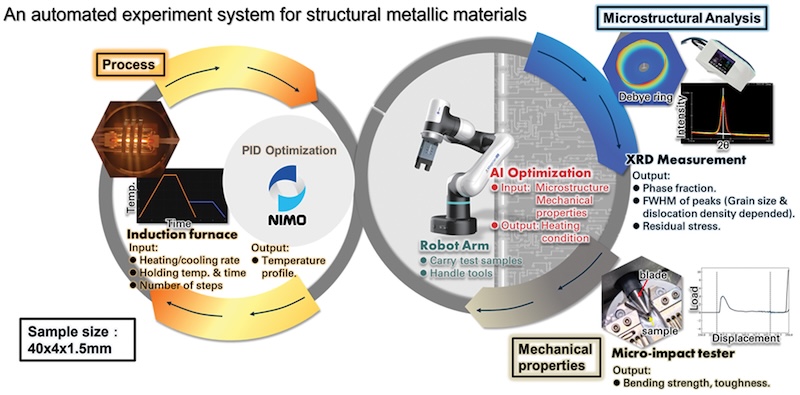
“Solid metal specimens are difficult to handle automatically, and the experimental equipment often requires considerable space,” explained Yulin Xie of Tohoku University, the study’s lead author. “Our platform addresses this challenge by integrating heat treatment, structural analysis, and mechanical testing into a single automated workflow.”
The team developed a robotic platform that heats solid metal specimens, examines their structure with X-rays, tests their mechanical properties, and then recovers them. The automated handling, treatment, and recovery of each specimen takes about 13 minutes, not including the time for the heat treatment. All manipulation and measurements are performed automatically.
“The platform records how processing affects structure and properties, generating data for AI-based materials development,” said Xie.
The researchers tested the platform with automated experiments measuring the properties of an alloy after one- and two-step tempering. The results were consistent with measurements in manual experiments, validating the automated experimental platform. Xie said the team also demonstrated AI-assisted adjustment of the furnace controls, laying the groundwork for closing the automation loop.
The next step is to enable an AI system to set the platform’s heat-treatment conditions based on the results of the previous experiment. That would create a closed loop where the results of automated experiments guide the design of the next experiment.
“Building on the furnace-control optimization we already demonstrated, we aim to establish an autonomous laboratory that discovers promising heat-treatment routes and accelerates the development of stronger and tougher structural metals,” said Xie.

来源:Robotics & Automation News · roboticsandautomationnews.com